
How to compare two skincare products without changing your whole routine
A useful product comparison begins before either bottle reaches your face: define the job, compare the labels, keep the surrounding routine stable, and decide what evidence will count before you look for a winner.

The short version: compare the two labels side by side first. Confirm that the products are candidates for the same routine job, choose one active product, keep the rest of the routine as steady as practical, and set a review date. Do not alternate randomly, stack both, or change several surrounding steps and then call the result a product comparison.
A side-by-side product comparison worksheet
Copy this into a note or print this page, then replace the prompts with your own details. This is a planning worksheet, not an automatic app import.
| Record | Product A | Product B |
|---|---|---|
| Question | What decision am I making? | What decision am I making? |
| Exact product / size | Copy from packaging | Copy from packaging |
| Price paid | Record in the same currency | Record in the same currency |
| Label directions | Copy without changing meaning | Copy without changing meaning |
| Routine slot and switch date | Keep a dated note | Keep a dated note |
| Practical observation | Texture, packaging, time or cost | Texture, packaging, time or cost |
| Decision | Keep A / keep B / neither / incomplete | Keep A / keep B / neither / incomplete |
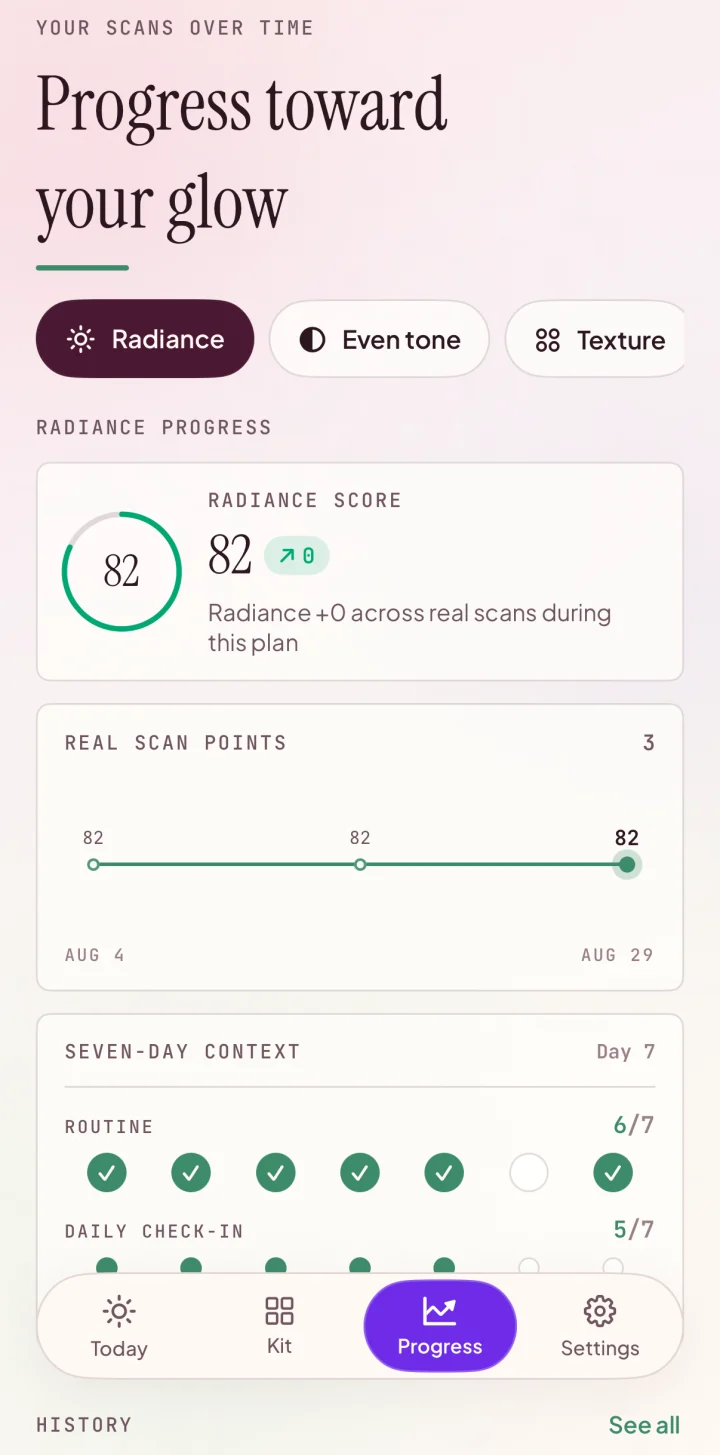
Use My Shelf to identify the product in your routine and Progress to review scan and routine context. Keep the two-column comparison, prices, label details and switch dates in your own worksheet. GlowKit does not search a product catalog, compare shopping prices or determine which formula caused a change.
See this GlowKit feature, or download GlowKit for iPhone to keep your routine close at hand.
On this page
Two products can look easy to compare because they share a category name, a highlighted ingredient, or a similar promise on the front of the package. That is not enough to make the comparison fair. Their directions, warnings, format, amount, routine slot, storage needs, and intended cosmetic role may differ.
The first question is therefore not “Which is better?” It is “Better for which defined job, under which constraints?” Once the job is clear, you can decide whether the answer already exists on the label and price card or whether you need a routine-history comparison.
Check whether the products are candidates for the same job
Give the comparison one sentence: “I am choosing one product for [specific routine slot] because [practical reason].” A useful job might be “the moisturizer in my established evening routine” or “the cleanser I can reliably replace when the current bottle is empty.” A vague job such as “make my skin better” cannot tell you which facts matter.
Then check three types of match:
- Role match: would each product occupy the same morning, evening, or scheduled slot?
- Direction match: can each product be used within the routine you actually follow, according to its own directions and warnings?
- Decision match: are you comparing the same outcome—such as cost per use, application experience, packaging convenience, or visible cosmetic progress?
If the products belong to different roles, stop calling the task a head-to-head comparison. Record them as separate products in your product inventory. You may still choose between purchases, but the decision is about priority, not proof that unlike products are interchangeable.
Build a label-first comparison card
Before opening a new bottle, copy the same fields for Product A and Product B. Use the packaging, insert, and official product directions—not a retailer summary or an old photo of a previous formula—as the source record.
Copyable product card: exact product and version — intended routine role — directions and stated frequency — warnings or limitations — ingredient panel captured on [date] — package amount — purchase price and date — open date or unopened — storage directions — reason it is being compared.
The FDA advises consumers to read the complete cosmetic label, including the ingredients, warnings, and directions for safe use. It also notes that terms such as “hypoallergenic” and “natural” do not by themselves establish what many shoppers assume. Keep marketing words in a separate “claims” field so they do not silently become facts.
For price, compare what you can verify. Package price alone may hide different amounts, and an estimated cost per use depends on how much you actually use. Label an estimate as an estimate. Do not invent an exact value when the pump, dropper, texture, or directions make it uncertain.
Product facts
Directions, warnings, ingredient list, amount, price, packaging, open date, storage, and where the product fits.
Routine evidence
Actual use, missed uses, surrounding changes, application notes, comparable photos, and the review decision.
Decide whether you need before-use facts or routine evidence
Many comparisons do not require two open products. If one option does not fit the needed slot, conflicts with a practical constraint, exceeds the budget, or lacks directions you can follow, the label-first scorecard may finish the decision.
A routine comparison is useful only when the unresolved question depends on your experience over time. Examples include whether the application experience fits a morning schedule, whether the packaging is easy to use consistently, or whether comparable progress records support keeping the new product in the same cosmetic role.
This is different from using an ingredient checker. Ingredient tools can help organize product information, but a formula summary cannot reconstruct when a product entered your routine, whether you used it as planned, or what else changed in the same window.
Protect a stable routine baseline
Write down the surrounding routine before Product B replaces Product A. Include the exact active products, morning or evening placement, any scheduled products, and the date of the switch. The baseline does not need to be perfect; it needs to be understandable.
Keep these guardrails visible:
- One active candidate for the slot. Do not alternate A and B by mood and expect a clear timeline.
- No automatic stacking. Using both together answers a different question and may not match either label.
- No unrelated launch week. Avoid adding multiple new products, changing the photo setup, and replacing the routine schedule in the same window.
- Record exceptions. Travel, skipped routines, a changed label, an empty bottle, or a different product should not disappear behind a completed checkbox.
- Follow exact directions. The comparison plan never overrides the package or individual professional guidance.
The American Academy of Dermatology recommends starting with one new product when adding anti-aging skincare products, partly because multiple simultaneous additions can make the routine harder to tolerate and interpret. The general organizational lesson is useful here: one meaningful variable creates a cleaner history than a bundle of changes.
If either product is new to you, use the product's directions and appropriate safety guidance before full routine use. The patch-test guide explains a label-led planning record without pretending that a home test can guarantee future compatibility.
Set the review rule before looking for a winner
A comparison without a review rule tends to end on whichever day feels most convincing. Define the rule while you are still neutral.
- Question: what single decision must this comparison support?
- Start: when does Product B actually replace Product A in the named slot?
- Evidence: which facts or observations will you collect?
- Consistency: which parts of the routine and photo setup should remain steady?
- Review date: when will you look at the complete record rather than reacting to every day?
- Exit rule: what label warning, unexpected reaction, packaging problem, or practical constraint ends the comparison early?
Do not invent a universal product trial length. Different products have different directions and practical review needs, and cosmetic observations do not all move on the same schedule. Choose a review date that fits the exact product information and your decision, then record why you chose it.
For progress photos, hold lighting, camera distance, angle, expression, and timing as steady as practical. The progress-photo guide helps reduce capture variation, but even a consistent photo is evidence for a trend—not proof of product causation.
Read the result without forcing a winner
Review the product card and routine record in separate passes.
Pass 1: practical fit
Ask whether the product fit the named slot, directions, budget, application time, packaging needs, storage conditions, and routine you were willing to maintain. A product can be a poor fit even when you have no dramatic photo difference.
Pass 2: record quality
Check whether the active product, dates, actual use, surrounding routine, and photo conditions are clear. If the history contains several unexplained changes, the honest result may be “comparison incomplete.” That is more useful than turning a noisy window into certainty.
Pass 3: the next decision
Choose one of four outcomes: keep Product A, keep Product B, pause and gather missing facts, or choose neither. “Neither” is a valid result when both products fail the defined job. Do not keep buying candidates merely because a comparison template has an empty winner field.
A visible change after a switch is an association within your record. It does not establish that one cosmetic caused the change, rule out other influences, or diagnose a skin condition. If you experience a reaction or a concern that needs individual assessment, stop using the comparison as a decision-maker and seek appropriate professional guidance.
Common product-comparison mistakes
- Comparing front-label hero claims. Start with the complete directions, warnings, ingredient panel, amount, and actual routine role.
- Treating shared ingredients as identical formulas. An ingredient list does not reveal every formulation detail or guarantee the same experience.
- Opening both products without a plan. This adds cost, age tracking, and pressure to finish both before the decision is clear.
- Alternating products randomly. A mixed timeline cannot cleanly describe either candidate.
- Changing the whole routine for Product B. You are then comparing two routine states, not just two products.
- Choosing the most dramatic photo pair. Compare the planned records under similar capture conditions.
- Declaring a medical winner. A cosmetic routine log is not a diagnostic or treatment study.
Where GlowKit fits
Use My Shelf to identify the product in your routine and Progress to review scan and routine context. Keep the two-column comparison, prices, label details and switch dates in your own worksheet. GlowKit does not search a product catalog, compare shopping prices or determine which formula caused a change.
GlowKit organizes cosmetic routines and progress. It does not replace product directions or establish that a product caused a visible change. See current free and Pro features.
- See how the guided GlowKit scan flow works.
- Use the scan consistency checklist.
- Read how GlowKit handles scan photos and account data.
- Browse all GlowKit guides.
Related guides
Read skincare labels before comparing claims
Capture directions, warnings, ingredient order, and the exact product version before it enters the scorecard.
Change historyTrack one meaningful routine change at a time
Protect a stable baseline and record the actual change date before reviewing a visible trend.
InventoryGive every product one status and next decision
Separate active products, backups, paused items, and unopened candidates before another purchase.
Product versionsKeep old and reformulated products as separate records
Compare current labels and preserve the exact routine date when one version replaced the other.
FAQ
What should I compare when choosing between two skincare products?
First compare the intended routine role, directions, warnings, exact ingredient panel, amount, price, packaging, storage, and practical constraints. Use routine evidence only for questions that depend on your experience over time.
Should I use both skincare products at the same time to compare them?
Not as a default comparison method. Stacking or random alternation changes the question and can make the timeline harder to interpret. Follow the directions for each exact product and keep only one active candidate in the comparison slot.
How long should I compare skincare products?
There is no universal comparison length. Use the exact product directions, the practical question you are answering, and any qualified individual guidance to choose a review date. Record the rule before the comparison begins.
Can progress photos prove which skincare product works better?
No. Consistent photos can make visible trends easier to review, but they do not prove causation, rule out other influences, or provide a medical conclusion.